Likes

Alternatives of google adsense

Don’t want to work with Google AdSense? No problem. There are many alternative ad networks available for those who don’t want or can’t work with Google for some reason.
Let’s look at some common scenarios in which people seek out alternate means of monetization.

Reasons to Look For AdSense Alternatives

There are many reasons to look for AdSense alternatives—the most important being to create a hedge against unexpected account troubles and suggest drops in revenue. Some other reasons I commonly hear about include:
  • Google AdSense rejects many sites for not having enough content or if they feel your site would not be appropriate for their advertisers.
  • Getting a site approved for Google AdSense is not as easy as it was in the past.
  • If you read any of the internet marketing or webmaster forums, I’m sure you’ve seen thread after thread with a title that goes something like… “AdSense banned me! Why?”
  • Google AdSense has a lot of rules and they monitor sites constantly. If you happen to break even one rule, they will not just ban the site, they will ban you and won’t let you open a new AdSense account. And even if you manage to open one somehow and they catch you later, they will ban the new account.
  • Did you know that if you even accidentally click on an ad on your site you could be banned for life?
  • Many site owners feel that Google AdSense rules are just too strict. Conforming to the many rules often leads to site design issues.
  • In some instances, you have to redesign your entire site just so you can use Google AdSense.
  • Contextual text ads sometimes just don’t fit a site’s design and layout. Other ad formats that Google AdSense does not support work better on many sites.

Types of Ads

Now let’s briefly take a look at the main types of ads available to publishers looking to shift to an AdSense alternative.
Targeted Text Ads: These ads are text-based and are usually found in groups. They are targeted to match the site’s content or the search phrase that was used on a search engine to bring them to your site’s page.
In-Text: These style of ads popup when you hover over selected text phrases with your mouse. A small box pops up and usually contains either image, text or video as well as the ad’s link.
Display: Display ads contain images, headlines, body text and other elements used to get a viewer’s attention. Sizes range from eighth page to full page ads.
Banner: These are your typical image ads you see on many sites. They can be just the image or an image with a text line above or below it. Sizes range from button size to half page and come in all orientations.

Alternative Ad Networks

Here are the top alternative ad networks that you can use instead of Google AdSense. Take your time and check out each one of them. You should find several that will work well with your sites.

1. Media.Net

AdSense Alternatives: Media.net
Media.Net gives you exclusive access to the Yahoo! Bing Network. They are one of the world’s largest contextual ad networks and boast many top publishers like Forbes, ELLE, Reuters, and Good Housekeeping.
Media.Net offers publishers several ad styles. Do note however that they only allow one of each ad type to appear on a page.
The main ad style available is the content ad. These are contextual ad blocks that are available in different sizes to suit your needs.
The next ad type available is the search targeting ad. These appear the same way as contextual ads but are only displayed to search engine traffic.
Media.Net also provides web bar and mobile ads to its publishers.
I feel that this is the closest AdSense alternative currently available. But, be aware that they are known for suspending accounts and not stating the reason. So, if you use them, read all the rules and be careful to follow them.
Possible roadblock: Media.Net needs to approve each site you want to place ads on. And they’re a little strict on what sites they approve.


2. Adsterra

AdSense Alternatives: Adsterra
Adsterra is a premium advertising network serving over 10 billion geo-targeted ad impression per month. They offer various popular ad formats for web and mobile devices: popunders, standard banners, pushups, interstitial, sliders, and direct links.
Adsterra works with websites from all types of niches and have a great ad fill rate for all countries. They are a perfect alternative to AdSense.
Publishers can enjoy on-time payments made bi-weekly via major payment systems, as well as a personal account manager and real-time statistics provided through Adsterra API. Adsterra also offers a 5% Referral program.

3. Ad Maven

Ad maven
In the past year Ad Maven has positioned itself as one of the top alternatives to Google Adsense. Offering their publishers a wide range of monetization methods such as Banners, Popunder, Lightbox, Interstitial, Slider ads and more – they serve over 500 million full page ad impressions per day.
Once you register you will be immediately approved and receive access to Ad Maven’s user friendly platform. Ad Maven identifies your website type and presents to your users ads that are most likely to convert, thereby increasing your revenues for all GEO’s.
Ad Maven also supplies a unique Adblock bypass solution allowing you to present ads to 100% of your users, increasing your revenues by up to 50%. The Ad-Maven products including Lightbox and Interstitial ads are fully compliant with Google Adblock scheduled to launch in January 2018 and will not be blocked.
The network also launched “Native push notifications” recently. This is a clean, user-friendly, and non-intrusive ad format compliant with Google policy which can be used alongside AdSense ads for mobile and desktop. The format gives high conversion rates without taking up space on the web pages or redirecting users to different sites.

4. AdBuff

Adbuff is the ultimate AdSense Alternative ad network due to their ability to outperform AdSense for many publishers. Because Adbuff is a Real Time Bidding (RTB) platform, AdSense is competing directly with other advertisers to monetize your site through Adbuff. As a result publishers earn some of the highest page RPMs available in the industry. Their ads are also fully compliant to run along-side AdSense, so you can even double your page RPM by running AdSense and Adbuff together.
adbuff_adpushup
Adbuff is an AdSense Alternative ad network that has strict approval guidelines for publishers and advertisers. They are currently accepting publishers who have English sites with a majority of the traffic coming from USA, Canada, Australia and the UK. Publisher sites require at least 2,000 unique visitors per day. Approval times can take between 5 – 7 days and every approved site will receive a $25 welcome bonus for signing up.
For premium publishers who are looking for the best AdSense Alternative ad network, Adbuff is the first ad network you should look at.

5. Infolinks

AdSense Alternatives: Infolinks
Infolinks ad network currently serves targeted ads on over 125,000 websites. They work best on sites that contain large amounts text-based content.
Infolinks indexes your pages to determine the best ads to display. Several types of ads are available to publishers for use on their sites.
The main ad type Infolinks provides is their in-text ad links. Selected words on your page are selected and either double underlined or dotted underlined. When a visitor scrolls over one of the words, a pops up containing an ad relevant to the word appears.
These ads can appear a little spammy and get a little annoying when you accidentally move your cursor over a link. They do allow you to limit the number on a page, though.
They also have an ad block called related tags. These are very similar in look to AdSense horizontal link blocks.
A tag cloud ad block is available for your use if you feel it would be suitable for your site’s layout.
Infolinks has a search widget that sits at the bottom of the screen and when a visitor moves their cursor over its bar, it slides up to display its contents.
Infolinks will not approve a site if they feel it is thin on content.

6. RevenueHits

AdSense Alternatives: Revenue Hits
RevenueHits is a fairly new ad network and looks very promising. They offer a nice variety of ad types including banner, pop-under, sliders, top and footer style banners, buttons, and interstitials.
They offer both contextual and geo-targeted ads. They are a performance-based network (CPA), not a CPC or CPM network. So make sure you understand that you are paid when a visitor to your site takes specific actions instead of being paid when they click on an ad.
RevenueHits offers payment via wire, PayPal and Payoneer. The current minimum payout is $50.
They do not allow ads to be placed on pages that do not contain content.

7. Chitika

AdSense Alternatives: Chitika
Chitika is an online advertising network with over 350,000 publishers. They serve over four billion targeted ads per month. Chitika has several top-tier advertising partners like Yahoo!, SuperMedia and HomeAdvisor.
Since the Chitika ads are search targeted, they work best with websites that get most of their traffic from search engines. Visitors that arrive at your site by other channels are displayed generic ads loosely based on your site’s title and keywords. If the majority of your traffic is from links or type-ins you may want to look at other AdSense alternatives.
They do allow you to use alternative ads that you can display to your non-organic visitors to better make use of your site’s ad space.
Publisher payments are available by PayPal starting with a $10 minimum.
Chitika is one of the few ad networks that has an affiliate program. This could bring in an additional income for you.

8. Adversal

AdSense Alternatives: Adversal
Adversal is an excellent alternative to AdSense if your site gets over 50,000 page views per month. They have fast approvals but make sure your site meets their requirements before you apply to be a publisher. They offer various banner sizes and types to publishers. Pop-unders and ministitial type ads are also available for publisher use.
Currently, their minimum payout is $20. A PayPal option is available. Adversal is also one of the few ad networks that have an affiliate program.
Please be aware that Adversal will reject any site that does not receive at least 50,000 page views per month.

9. Clicksor

AdSense Alternatives: Clicksor
Clicksor offers publishers multiple ad formats including clickable text and targeted contextual banner ads for use on their sites.
All ads displayed to your site’s visitors are context sensitive. This way your site visitors see ads that they will be more likely to click. They offer weekly payouts via PayPal or check. The minimum payout threshold is currently $50. Clicksor also offers an affiliate program that pays a 10% commission.
Caveat: They’re getting more picky on which sites they accept and are rejecting many sites that are not based in the US, Canada or the UK.

10. BidVertiser

AdSense Alternatives: Bidvertizer
BidVertiser pays you on both clicks and conversions. This could help you make more money from your sites.
Text ads, banner ads, mobile ads and slider ads are available. They offer publishers a point-and-click ad builder tool that helps you to customize the ads to fit the look and feel of your site. They pay monthly by check, wire or PayPal. The current minimum payout is only $10 if you choose to receive payments through PayPal.
One downside to BidVertiser is that they use an advertiser bidding system. Each advertiser bids ad placement and what sites their ads appear on. So, it may take some time for advertisers to find your site in the BidVertiser network and start bidding on your ad spots.

11. Intellilinks

AdSense Alternatives: Intellinks
Intellilinks lets you sell simple text links on your sites to advertisers for a set monthly fee. The more traffic you have and the better your search engine rankings, the higher you can set your monthly charge.
If you have a site that is ranked well and receives a good amount of traffic, you will want to take a close look at Intellilinks. For integration, they provide a WordPress plugin or script that is easy to install. This plugin or script automates the process of adding text links to your site. Sold links can be placed inside of content and on the sidebar as related links. Your site visitors do not have to click these links for you to be paid. Payments are made through PayPal on a monthly basis.
One negative thing about Intellilinks is that it may take time for advertisers to purchase links on your site.

12. PopAds

AdSense Alternatives: PopAds
PopAds specializes in pop-under ad delivery.
They claim that their average earnings for a site that receives 1000 unique visitors a day is $4.00 a day. You can select the minimum bid you will accept from advertisers as well as setting the frequency with which the pop-under ads display to site visitors. One of the great features of PopAds is that you can request payment of your PopAds revenue anytime you want. If you are earning at least $5 a day, you can even make payment requests on a daily basis.
Getting an account and site approvals is easy with PopAds.

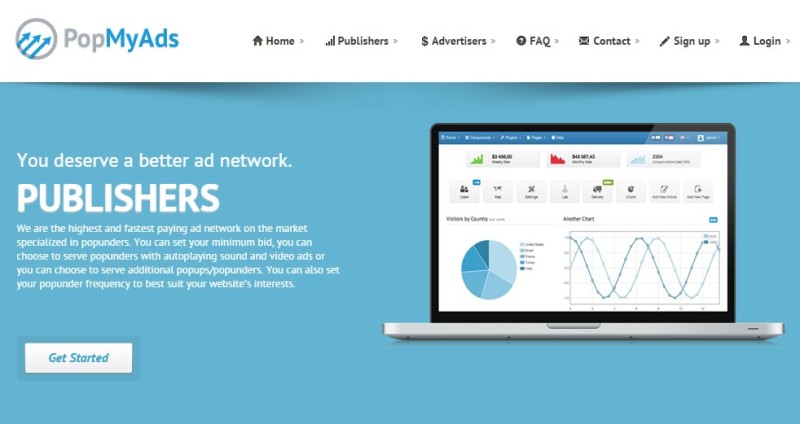
13. PopMyAds
AdSense Alternatives: PopMyAds
PopMyAds is a pop-under ad network that accepts publishers and traffic from all countries.
They provide quick site approval; many times in under one hour. This is one of the few ad networks that accepts legal adult sites. Please check their TOS for more details on the sites they accept.
Their minimum payout is just $5.00 and can be paid through PayPal or Payza. You can contact them if you need to be paid through wire transfer. All payments are processed in 1 to 7 business days. PayPal and Payza payments are usually processed within 1 business day of the payment request.

14. PropellerAds Media

AdSense Alternatives: Propeller Ads
PropellerAds is a large ad network that specializes in pop-under ads but also provides standard banner ads, on-click ads, and in-banner video ads. They also have sliders, sponsored links and other ad formats available for publishers.
If your website is in one of the following niches, you will want to check them out: Games, entertainment, movies, dating, finances, software or gambling.
They also have a great ad fill rate for tier 2 and 3 countries. So if you have site visitors from India, South Africa or Singapore, you should give them a try.

15. Vibrant Media

AdSense Alternatives: Vibrant
Vibrant Media is an extremely popular ad network that you will see at work on many popular sites. They have many premium advertisers and pay high CPC rates to their publishers.
Let me give you an advance warning, though. They are very picky about what sites they accept. Any site you submit to them for approval must be of high quality and receive a minimum of 500,000 page views per month.
Vibrant use their own IntelliTXT technology that searches your pages for relevant keywords and phrases. It then underlines these and adds the code needed to open a small popup when the user hovers over the link. These popup ads are interactive and draw a high number of clicks. Vibrant also offers other ad types, including in-image and display.
Though site approval is difficult, if you do have a site that meets their minimum criteria, they are a great network to be on.

16. VigLink
AdSense Alternatives: Viglink

VigLink helps you to monetize your sites by automatically converting key phrases and existing links into affiliate links.
VigLink supports over 32,000 affiliate merchants and pays you between 25% and 50% of all revenue earned by clicks on links converted by VigLink.
Currently, they offer three types of monetization technologies. Their VigLink Convert service takes many of your regular links to products and converts them to links that will earn you a commission if the product is purchased by the visitor clicking the link. VigLink Insert takes keyword phrases from your site and converts then into affiliate links. This works great if your site discusses a lot of products.
The third technology they offer is VigLink Anywhere. This technology is designed for sharing links via Twitter, Facebook, email etc. It’s easy to get approved and account activation is instant once you verify your email address. If you have been turned down by other networks, this one is worth checking out.

17. BuySellAds

AdSense Alternatives: BuySellAds
BuySellAds sells advertising space on your site to advertisers for you.
When you submit a site to BuySellAds for approval they look at your PageRank, Alexa score, inbound link count and other metrics to determine your site’s overall quality. They only accept high-quality sites.
You actually have control of what you feel your ad space is worth. But, be careful that you don’t price yourself out of the market. BuySellAds supports many ad types, including background takeovers, display, email newsletters, RSS feed ads, image plus text, text ads etc. They pay you 75% of the revenue your ad space brings in. BuySellAds only accepts English language sites. You also need to have a minimum of 100,000 page views per month.
Also, note that you must own the domain. They do not allow sites on wordpress.com, Blogger, etc. There are many reasons why people look for alternatives to AdSense. Getting rejected, getting banned, overly strict rules, and that sometimes contextual text ads just don’t work with a site’s design.
Now it’s time for you to explore all the options you have and pick the ad networks that works best for you, your sites and your goals.

Asp & Mvc Mt Solved


Ques1 Conside a scenario where you are trying to directky deploy a web application on the IIS server of your development computer.As the first step Internet Information Services(IIS) Manager and currently accessing the Add Apllication dialog box.At this stage which of the following information (ch11)


1.A name of the application,A URL to access the application
2.The pysical path where the website will be saves,A URL to access the application
3.An Alias name of the application,The physical path where the application will be saved
4.The URL to access IIS,The physical path where the website will be saved.


================================
Ques2 When you execute the application,the application is automatically deployed on____.
(ch11)

=====================
Ques3 DatePicker Code(ch8)
====================
Ques4 Create CSS file code(ch6)
===============
Ques5 The IEnumarable interface is avaible in the ____ namespaces.(ch6)
===============
Ques6 Range Data Annotation(ch4)

=====================
Ques7 To implement client-side validation in an MVC application,which one of the follwing options is not required?
1.Add annotation to the model class
2.use HTML validation helpers in Razor view to display error message
3.Include the jQuery validation script
4.Add custom error message to annotation in model class
=========================
Ques8 Which of the follwing statements is true regarding the ReadOnly attribute applied to a property? (ch 4)
1.Ensures that the property is not made availble to the view
2.Specifies constraints for a numeric value entered by the user
3.Ensures that the default model binder will not set the property with a new value from the request
4.Helps you provide information about the specific purpose of a property at runtime
=========================
Ques9 In server-side validation,if the model state contains an error,the ____property retuns false
1.ModelState.IsValid
2.ModelState.Valid
3.ModelState.IsError
4.ModelState.IsInValid
=========================
Ques10 Which one of the following code snippet will generate a URL of the Login action in the Account controller?
1.@HTMl.ActionLink("Login","Action")
2.@Url.ActionLink("Login","Action")
3.MvcHtmlString.ActionLink("Login","Action")
4.@Url.Action("Login","Account")
=====================
Ques11 RadioButton coding(from book Topic Helper Method)
====================
Ques12 The _____ helper method is used to display an editor for the specified model property.
================
Ques13 Custom Route(Go through the Animation)

Identify the URL that cannot match with the following
===================
Ques14 What wll be the result when the following URL is sent to an MVC application through a Web browser?
http://newbay.com/Index/RegistrationController
=====================
Ques15 Chris is given an existing ASP.NET MVC application created by using scaffolding feature.In the application,he has to make changes to the HTMl template.Which options?
1.Views folder
2.Web config file
3.App_Data folder
4.Controller folder
=======================
Ques16 You have created a controller for a web apllication with the name Tutorial.What will be the name of the folder created by default under the Views folder if you use the scallofding
1.Tutorial
2.TutorialController
3.Home
4.Controller
=============================
Ques17 FadeIn() and FadeOut() methods of JavaScript coding
=========================L

WCD MT SOLVED

1.Define the following terms:Purchase OrderDelivery ChallanRejection NoteGoods Received NoteGoods Inwards Note
Ans:
i)Purchase Order - A document from the customer to the seller listing the required items and providing a description of the goods.
ii)Delivery Challan - A document that is sent with the shipment of goods. It lists the description, and quantity of the goods that are delivered.
iii)Rejection Note - A document that lists the materials that are rejected due to defects found during quality inspection. The reason of rejection is also included.
iv)Goods Received Note - A document that acknowledges that the materials have been inspected and accepted by the manufacturer.
v)Goods Inwards Note - A document that records the entries of the materials when they are received at the store of the organization.

2.Identify the various criteria for classifying an organization and discuss them in detail.
Ans:
An organization consists of a group of people working specifically to achieve a common goal. Organizations can be classified on the basis of nature of work, profitability, type of system, and ownership

i)Based on the Nature of Work:
Organizations can be classified depending on their nature of work as:

a)Manufacturing-based: Business organizations involved in producing tangible goods or products are called manufacturing organizations. b)Automobile manufacturing companies, iron and steel plants, and food and beverage processing units are examples of manufacturing organizations.
c)Service-based: Business organizations involved in providing services to other businesses or people, rather than producing tangible goods, are called service-based organizations. Airlines, hotels, hospitals, banks, and insurance agencies are examples of service organizations.
Based on Profitability:

ii)Organizations may be classified on the basis of their focus on profit. These organizations can be:

a)Profit-based organizations: The primary goal of these organizations is to increase their profit margin. These organizations try to increase the value of their share by increasing the value of the company stock.
b)Nonprofit-based organizations: These organizations do not have profit as their primary goal. They are usually involved with socially relevant issues. Some examples of nonprofit organizations include social groups, universities, human rights commissions, and worker unions.

iii)Based on the Type of System:
Based on the type of system an organization implements, it can be classified as simple or complex and adaptive or nonadaptive.

a)Simple or complex: A simple system consists of a lesser number of elements that interact with each other in a simple and uncomplicated manner. An eating joint is an example of a simple system, wherein the customer places an order, the ordered food is prepared, and the food is served to the customer.  Components in a complex system have a high level of interaction with each other. A car manufacturing organization is an example of a complex system.
b)Adaptive or nonadaptive: An adaptive organization is one that is able to change in response to the changes in the environment. For example, the fashion and cosmetics industries are highly dependent on external stimuli. A nonadaptive organization is one that is not able to change easily in response to external stimuli. For example, the automobile industry needs to take many factors into account before deciding on a change. These factors may include the cost of manufacturing a modified product or the availability of raw materials.

iv)Based on Ownership:
On the basis of the nature of ownership, business organizations can be classified into the following types:

a)Sole proprietorship: When one individual heads a business organization, it is said to be sole proprietorship.
b)Partnership: A partnership organization has two or more individuals conducting the business together. Corporation: A corporation is a legal entity conducting business with numerous owners.

3.Explain the following terms briefly:
Test case
Collaboration
Generalization
Job shops
Batch processing
Ans:
i)Test case: A test case is a set of actions that is executed to examine whether or not the implemented code of the software system complies with the requirements stated by the customer. This helps you to validate the system functionality against system requirements. A test case developed for a particular function of the software system includes a set of test input, execution conditions, and expected results.
ii)Collaboration: UML provides specific modeling constructs, known as collaborations, to model a use case realization in the design phase. Collaboration is a collection of classes, interfaces, and sub-systems that interact with each other to achieve the functions of a use case. It can be represented by creating an oval with a dotted line.
iii)Generalization: The generalization relationship exists among the actors or use cases that have similar behavior and properties. Two actors or use cases are said to have a generalization relationship when the characteristics of one actor or use case can be derived from the characteristics of another actor or use case.
iv)Job shops: The Job shop production process involves the manufacturing of a wide variety of products in small numbers for a specific customer requirement. This production process is used to make a higher number of products as compared to projects. Job shops require general-purpose equipment that is flexible, because every product goes through a different sequence of processes. In job shops, resources are sometimes overloaded, while at other times, they may be idle. Examples of a job shop include manufacturing of special items, such as furniture.
v)Batch processing: The batch processing production process involves large-scale manufacturing of products on the same equipment. Every new product incurs additional setup costs that can be reduced by manufacturing more units in each cycle. Products are stocked and supplied based on customer demand. Batch processing caters to those products that are generic in nature. Therefore, general-purpose equipment is used. The process does not undergo many changes, but skilled workers are required to perform tasks. Examples of batch processing include book publishing, garment manufacturing, and pharmaceutical production.

4.Describe the class diagram and class notations used in UML. Explain the visibility of attributes and operations in a class diagram. Explain the syntax of attributes and operations in class diagrams.
Ans:
Class diagram and class notations used in UML

A class diagram is used to create a structural model of a software system. The structural model describes the static architecture of a system and helps the software developer to translate the system use cases into system design.

 UML provides a class notation to represent classes in class diagrams. The class notation has three compartments where the first compartment depicts the name of the class, the second compartment depicts the attributes of the class, and the third compartment depicts the operations of the class.You can use class notations to document the design of a system in accordance with the requirements identified during the requirements analysis phase.
Visibility of attributes and operations

It is vital to ensure that the data of your classes remain secure. For this, UML allows you to specify the visibility of the class attributes and operations, which controls the accessibility of these class members from other classes. UML provides the following four visibilities for the attributes and operations of a class:

i)+: Indicates that the attribute or operation is accessible to other classes. In other words, the attribute or operation is public.
ii)-: Indicates that the attribute or operation is inaccessible to other classes. In other words, the attribute or operation is private.
iii)#: Indicates that the attribute or operation in the base class is accessible to derived classes. In other words, the attribute or operation is protected.
iv)~: Indicates that the attribute or operation is accessible to the classes, which are within the same package.
Syntax of attributes in class diagrams

The attributes of a class follow certain syntax in the class diagrams. The syntax to depict an attribute in a class diagram is:

visibility name: type

The preceding syntax contains the following mandatory fields:

i)visibility: Specifies whether the attribute of the class is private, public, protected, or package.
ii)name: Indicates the name of the attribute. This is a mandatory field.
iii)type: This is an optional field. It specifies the data type of the attribute.
For example, the Name attribute of the Employee class can be represented as:

-Name: String

Syntax of operations in class diagrams

The syntax to represent an operation of a class in the class diagrams is:

visibility name (parameter-list): return-type

The preceding syntax contains the following fields:

i)visibility: Specifies whether the operation of the class is private, public, protected, or package.
ii)name: Indicates the name of the operation.
iii)parameter-list: Indicates the list of parameters for the operat.
iv)return-type: Represents the data type of the value returned by the operation. This field can take the null value when the operation does not return any value.
The parameters of an operation are denoted using the following syntax:

Parameter name: type

For example, the getName() operation of the Employee class can be represented as:

+getName(EmpId : int) : string

5.What is meant by logistics? Explain the activities involved in logistics planning (any two) in detail.
Ans:
Logistics is a business-planning framework. It involves planning for the movement and storage of materials and information from any point in the operational process to the final order-fulfillment stage. Organizations thrive on the effectiveness and efficiency of their operational strategies. An efficient logistics plan supports in implementing the organizational processes, such as production and sales and marketing, effectively.

Logistics planning involves the following activities:

Analyzing the core business processes

Analysis of the core business processes of an organization is important as the logistics activities differ depending on the nature of the business undertaken by an organization.

Some of the general processes for a typical manufacturing-based business organization include:

i)Purchasing of material
ii)Receiving the material
iii)Warehousing
iv)Controlling the inventory
v)Handling the material
vi)Shipping
vii)Making decisions for physical distribution

The distribution of products is an important activity for an organization and its customers. For example, in a manufacturing organization, the goods are typically moved from the Production department to the warehouses, where they are stored until they are sent to the dealers.
The main factors to be considered while making decisions for the physical distribution are:

The size, number, and location of warehouses
The mode of transport depending on the type of goods, distances, and weights
The work force to be employed or hired.
Deciding the location of facilities:

Whenever an organization wants a new factory, warehouse, shop, office or other facilities, it is important to identify a strategic location.

Most organizations evaluate the feasibility of the location of a facility, such as a production plant, based on the factors, such as:

i)The locations of competitors, suppliers, and customers
ii)Availability of skilled workforce in the area
iii)Costs pertaining to operations, wages, transport, and taxes
iv)Transport and services availability
v)Plans regarding future expansion, or globalization

6.What is a state machine diagram? Explain its various components.
Ans:
Before developing a software system, a developer must understand the various states through which a component goes from its creation to termination. For this, UML provides a state machine diagram. A state machine diagram represents the various states that an object goes through during its lifecycle in response to events. You need to model the behavioral aspects of a system by using state diagrams. Therefore, you create a state diagram for the objects that respond to events. The various constituents of a state diagram are states, events, and transitions.

i)A state depicts a condition of an object and the activities of an object during its lifecycle. An initial state is the starting state of an object and is represented as a dot. A final state is the end state of an object and is represented as a dot encircled by a ring.
ii)An event is an occurrence that triggers a change of state of an object. It signifies the receipt of a message that requests for an operation to be performed.
iii)A transition is a change of state of an object due to the occurrence of an event. For example, the state of customer complaint transitions from Open to Closed when the Complaint Resolved on Phone event occurs. Similarly, the state transitions from Open to Waiting when the Complaint Not Resolved on Phone event occurs and from Waiting to Closed when the Complaint Resolved Onsite event occurs.

7.What is a product? Explain the product life cycle in detail.
Ans:
A product is an article or a substance that is manufactured or produced by a company for sale. The main objective of a product is to make the customer feel satisfied or benefited after the purchase of the product. Before marketing a product, it is important to understand the life cycle of a product in the market. When a product is launched, the demand for it varies with time. There are different stages through which the product passes when it is introduced in the market. These stages comprise the product life cycle. The life cycle of a product starts when it is launched in the market till the time it remains in the market. This life cycle helps organizations in analyzing the product's impact on the organization's market share. The different stages of a product life cycle are: introduction, growth, maturity, and decline.

i)Introduction: This is the first stage when the product is introduced in the market. The main focus of the organization at this stage is to make the customer aware of the product and its benefits. For this, organizations invest more in advertising and other promotional strategies. The focus is not on revenue generation.
ii)Growth: At the growth stage, once the product is established in the market, more retailers and customers are attracted to it. At this stage, the organization maintains the quality and price of the product to attract more customers. This results in profits for the organization.
iii)Maturity: At the maturity stage, the sale of the product first reaches saturation in the market. The distribution of the product reaches to the fullest in the market, leaving minimum demand for the product. Thereafter, its sale starts declining. The primary goals of an organization at this stage are to maintain the market share and promote the product by differentiating it from competitors? product.
iv)Decline: At the decline stage, there is a rapid increase of competing products that may be better in quality and low in price. As a result, sales start declining and production volumes need to be reduced. The primary goal of an organization at this stage is to try maintaining the sale of the product by adding new features and reducing the cost. However, if the product is still incurring loss, the organization may discontinue the product.

8.What is meant by logistics? Explain the activities involved in logistics planning (any two) in detail.
Ans:
Logistics is a business-planning framework. It involves planning for the movement and storage of materials and information from any point in the operational process to the final order-fulfillment stage. Organizations thrive on the effectiveness and efficiency of their operational strategies. An efficient logistics plan supports in implementing the organizational processes, such as production and sales and marketing, effectively.

Logistics planning involves the following activities:

i)Analyzing the core business processes

ii)Analysis of the core business processes of an organization is important as the logistics activities differ depending on the nature of the business undertaken by an organization.

Some of the general processes for a typical manufacturing-based business organization include:

i)Purchasing of material
ii)Receiving the material
iii)Warehousing
iv)Controlling the inventory
v)Handling the material
vi)Shipping
vii)Making decisions for physical distribution

The distribution of products is an important activity for an organization and its customers. For example, in a manufacturing organization, the goods are typically moved from the Production department to the warehouses, where they are stored until they are sent to the dealers.
The main factors to be considered while making decisions for the physical distribution are:

i)The size, number, and location of warehouses
ii)The mode of transport depending on the type of goods, distances, and weights
iii)The work force to be employed or hired.
Deciding the location of facilities:

Whenever an organization wants a new factory, warehouse, shop, office or other facilities, it is important to identify a strategic location.

Most organizations evaluate the feasibility of the location of a facility, such as a production plant, based on the factors, such as:

i)The locations of competitors, suppliers, and customers
ii)Availability of skilled workforce in the area
iii)Costs pertaining to operations, wages, transport, and taxes
iv)Transport and services availability
v)Plans regarding future expansion, or globalization

9.Explain the various stages of marketing process.
Ans:
The stages of the marketing process are analyzing the need for a product, deciding upon the marketing strategy, implementing the marketing strategy, and monitoring the product.

i)Analyzing the need for a product: While analyzing the need for a product, organizations need to analyze the customer's requirements and its own capabilities to manufacture a product. While planning for the marketing strategy for a product, an organization must analyze whether it has sufficient funds to be able to manufacture and get sufficient returns.
ii)Deciding upon the marketing strategy: After the analysis of the customer requirements and market trends, an organization needs to decide upon its marketing strategy. This strategy requires a decision on the marketing mix as well as a target market for which the marketing mix is prepared. The marketing mix consists of variables that marketing managers can control in order to best satisfy customers in the target market.
iii)Implementing a marketing strategy: The plan prepared at the decision stage of the marketing process is implemented at this stage. The product is launched in the market and the planned promotional strategies are implemented to ensure customer awareness and sale of the product. The launch of a product includes the following activities:
a)Product performance is evaluated through tests and quality checks.
b)Final packaging is designed and ordered.
c)Sales channels are identified and established.
d)Product feedback is updated based on market feedback and analysis.
e)Product documentation is completed and finalized.
f)User documentation, operating manuals, advertisement materials, product brochures, marketing materials, press releases, website pages, and maintenance instructions are completed and ready to be distributed at the appropriate time.
g)A Production Readiness Review document is prepared. This document confirms that all preparations are completed and the product is ready for launch.
h)The new product is launched when the service, sales, and distribution channels are ready.
iv)Monitoring the product: The task of the marketing team does not get over with the launch of the product in the market. At this stage, an organization needs to collect regular feedback from customers regarding their likes, dislikes, and suggestions for improvement of the product.  At this stage, competitors and their similar products need to be monitored closely and the marketing strategy may need to be modified accordingly.

10.What is structural modeling? List any three UML diagrams for structural modeling and explain them briefly.
Ans
UML provides various modeling techniques to represent the framework of a software system. Each modeling technique contains a set of diagrams to represent the requirements and structure of the software system. The UML modeling techniques may be used for structural modeling and behavioral modeling. Structural modeling involves depicting the static features of the software system. It is used to represent how the components or elements exist in a system.

The various UML diagram for structural modeling are:

i)Class diagram: A class diagram represents a set of classes, interfaces, and their relationships. It describes the set of attributes and operations associated with each class and the relationships among the various classes.
ii)Object diagram: An object diagram represents an instance of a class diagram. It represents the properties of a particular instance of a class.
iii)Package diagram: A package diagram represents the interrelated classes and interfaces of the system in a package.  It helps in representing the various packages of a software system and the dependencies between them. It also gives a high-level impression of use case and class diagrams.
iv)Component diagram: A Component diagram combines packages or individual entities to form components. You can depict these components and their dependencies by using a component diagram.
v)Deployment diagram: A deployment diagram shows the physical placement of components in nodes over a network. A deployment diagram can be drawn by identifying nodes and components.

11.Explain the concept of production planning in brief. Discuss in detail about the MRP phase of production planning.
Ans:
Production planning is an integral part of the production process. It is the first step in the production process. Every manufacturing-based organization performs a set of operations for producing finished goods. Each operation in the production process of an organization must be systematically designed, planned, organized, and controlled.

Production planning:

i)Helps organizations to develop and implement strategies so that cost-effective goods are produced with minimum resources.
ii)Involves the systematic scheduling of workers, materials, and machines for manufacturing products efficiently, economically, and timely.

The different phases of production planning are:
1. Material requirement planning (MRP)
2. Selecting the production process

MRP is an inventory control process used to calculate the amount of raw materials required to manufacture a specific product. MRP involves reviewing the stock quantity of raw materials according to the quantity of products to be manufactured in a specific period. It then involves calculating the quantity of components and materials required to manufacture those items and identifying the supply of materials required for the scheduled production. MRP involves planning work orders and purchase requisitions and suggesting appropriate rescheduling of the current material plan by taking into account the actual delivery date of a product.
The main inputs of MRP are:
i)Master Production Schedule (MPS) shows the quantity of products to be manufactured in a specific period. It is a detailed manufacturing plan that determines the products a manufacturer has to produce within predefined timelines. During MRP, the estimated plan provided by MPS is translated into a detailed plan that specifies the schedule for material requirement and delivery.
ii)Bill of Materials (BOM) consists of the materials, parts, and components that are required to manufacture the product. During MRP, the BOM and MPS are used to calculate the amount of each material required.
The lead-time is the time between the placement of an order for a product and the actual date of delivery. Determining lead-time of raw materials is essential for a manufacturing company so that the finished goods can be delivered to the customer in a timely manner and any shortages can be handled before the production process starts.
iii)Inventory records provide a detailed list of all the items that are currently in stock. The information is stored in a tabular format. MRP uses these existing inventory records to calculate the net quantity of materials required from the supplier. The net quantity required is calculated by subtracting the existing inventory from the total materials required as per MPS.
The main outputs of MRP are:
i)Schedule for Orders: It provides guidelines to place an order depending on the lead-time.
ii)Purchase Orders: It is a buyer's document and is used to formalize a purchase transaction with a supplier. On acceptance by the supplier, it becomes a legally binding contract between the two parties and hence, it must specify all terms and conditions applicable to the contract.
iii)Reports: The information from MRP is processed to generate various reports, such as performance reports and inventory transactions.